
How Stablecoins Reach Africa: The Fintech Playbook for 2026
Stablecoin demand in Africa isn't the question anymore. More than $205B flowed in last year. The real contest is the off-ramp: how a dollar becomes mobile-money cash. Here's how it works, and the decisions builders face in 2026.

Stablecoin adoption in Africa is no longer a forecast. Between July 2024 and June 2025, Sub-Saharan Africa took in more than $205 billion in onchain value, up 52% year over year, and Nigeria alone received about $92 billion of it, ranking sixth on Chainalysis's 2025 global adoption index. Sending $200 into the region still costs roughly 8.8% through legacy rails, nearly triple the UN's 3% target, while a cross-border transfer that runs 7-9% through traditional channels drops to 1-3% over a stablecoin rail.
So the real question for anyone building in African fintech in 2026 is not whether to use stablecoins. It is a set of concrete architecture decisions: which off-ramp, which chain, which coin, which compliance posture, and which interface. This piece walks through the decisions African fintech operators are making right now.
Why African Fintechs are choosing Stablecoins
In markets where the Nigerian Naira fell from roughly 460 per dollar in early 2023 to over 1,500 by mid-2024, a wallet holding USDT stops being speculative and becomes a savings tool. Chainalysis data shows stablecoins now make up roughly 43% of the region's crypto transaction volume, used as dollar substitutes rather than speculative bets. Traders price imported goods in dollar terms without keeping a formal dollar account. Businesses pay overseas suppliers without waiting on correspondent banking. The pull is protection against depreciation, cheaper cross-border settlement, and access to dollars for the more than half of Sub-Saharan adults who remain unbanked.
Off-Ramp Devices: USSD, Feature Phones, and Mobile Money
There is no single African off-ramp. There is a stack of overlapping mechanisms, each with different economics, liquidity depth, and regulatory exposure.
Mobile money is the default last mile. A stablecoin off-ramp is the process of converting a dollar-pegged stablecoin such as USDT or USDC into local currency a person can actually spend. In Africa that destination is usually a mobile money balance like M-Pesa or MTN MoMo rather than a bank account. USSD still carried 63.5% of African mobile money transaction volume in 2024, and 89% of mobile money interactions in the West African region run over USSD. Sub-Saharan Africa holds 1.1 billion registered mobile money accounts, more than half the global total, and a large share sit on feature phones or entry-level handsets that cannot run a typical blockchain application.
In Kenya, Zambia, Tanzania, and Uganda, people already link their mobile money wallets to crypto accounts, using the mobile money balance as both on-ramp and off-ramp. The destination is not a bank account, it is a telco wallet, which is the piece foreign entrants most consistently underestimate.
Licensed on/off-ramp operators are the connective tissue. Regulated entities convert between local currency and dollars and carry the heaviest compliance burden. Yellow Card is the most scaled African-founded operator, operating across more than 30 countries with a banking-partner network in the hundreds; it processed around $3 billion in 2024 and shut its consumer app in January 2026 to focus entirely on B2B stablecoin infrastructure, a strong signal about where the durable margin sits. Kotani Pay connects stablecoin rails to M-Pesa and Airtel including offline USSD flows, and became South Africa's first licensed on/off-ramp fintech; a UNICEF Venture Fund pilot found average off-ramp times of about 19 minutes, ranging from under a minute to over two hours depending on liquidity provider availability.
P2P is the fallback. Binance P2P and its equivalents remain central, especially in Nigeria, where regulation pushed the entire market into peer-to-peer channels for years. P2P provides liquidity but it can carry counterparty risk, fraud, and fake escrow exposure.
Invisible settlement is the emerging institutional model. The most interesting recent pattern hides the stablecoin entirely. In the Visa, M-PESA, and Onafriq pilot in the DRC, users send and receive local currency for cross-border mobile money top-ups while a stablecoin layer settles underneath, invisible to the end user.
The Decisions African Fintech Builders are Making in 2026
Put the market together and the build decisions come into focus. These are the choices on the table right now.
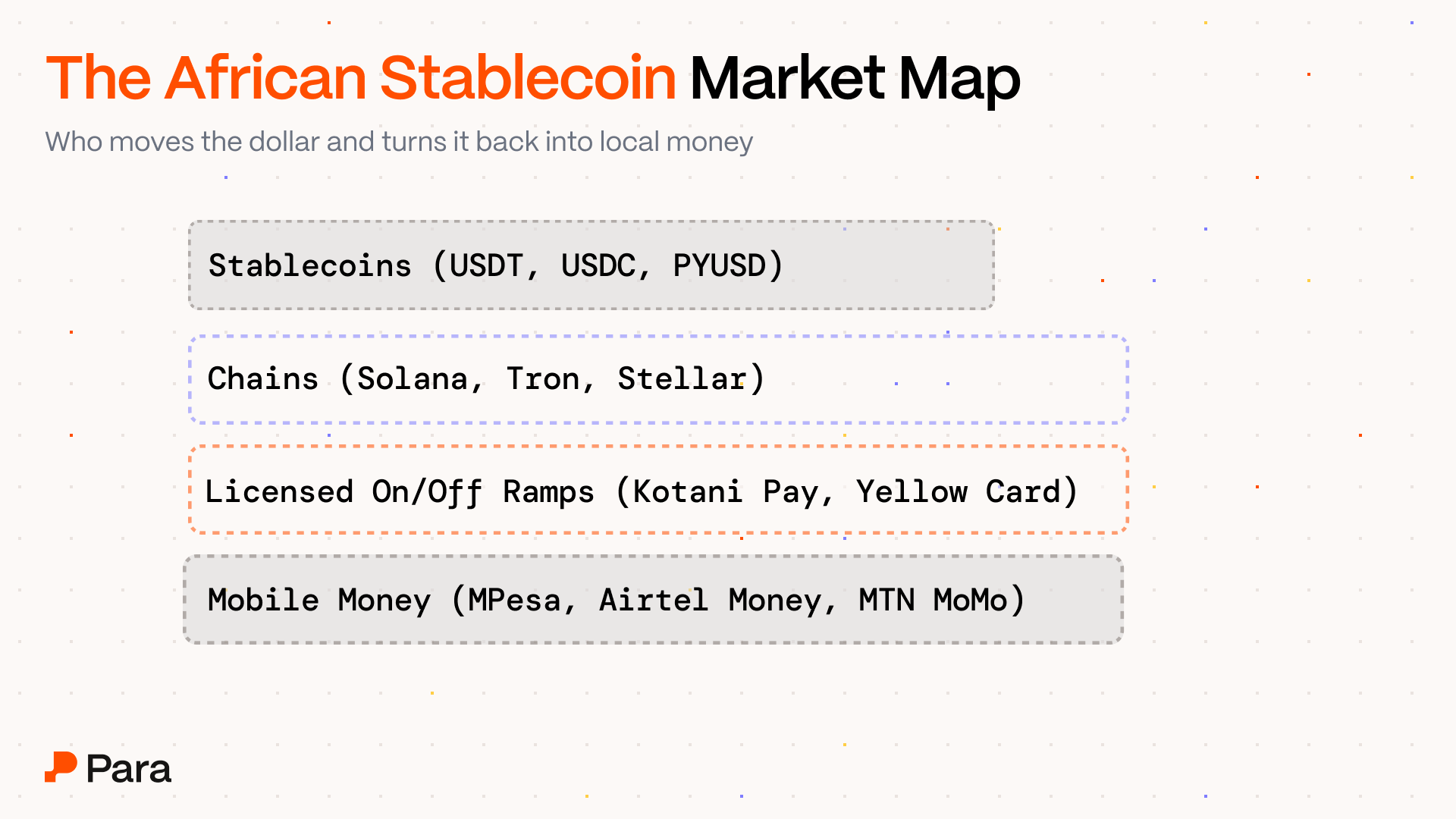
Buy the off-ramp, do not build it. The off-ramp is a licensing, banking-relationship, and liquidity problem in every market, and it does not get easier in the fiftieth country. Most 2026 builders integrate a licensed provider (Yellow Card, Kotani, Eversend and peers) rather than pursue money-transmitter licenses across dozens of jurisdictions.
USDT for reach, USDC for compliance. USDT dominates African liquidity; it made up roughly 88.5 percent of stablecoin activity in Nigeria in the Yellow Card data and has the deeper P2P and mobile-money liquidity that determines off-ramp speed. USDC, with monthly attestations and a framework built for GENIUS Act alignment, is the defensible choice when US interoperability or institutional compliance review is in scope. Many teams support both routes by corridor. Regulated local stablecoins like Nigeria's cNGN add a third option for domestic flows.
Chain choice follows the off-ramp. Solana is the pick where sub-second, low-fee consumer transfers matter (Western Union's USDPT and Xelio both settle there). Stellar anchors payments and aid corridors with an established off-ramp network (Coala Pay and MoneyGram). Tron is also a big chain for volume in the Africa market. What settles the decision is which chain the chosen off-ramp partner already supports, plus CCTP-style mobility to avoid liquidity getting trapped in one chain.
Solve custody and recovery for a mainstream, phone-first user. Seed phrases fail in this market. The workable pattern is a self-custodial account created from a phone number, email, or SIM identity, recoverable after a lost handset, on a wallet the user never has to think about as blockchain.
Case Studies: Stablecoin Products working in the African Market
A few products illustrate how the interface and the off-ramp get solved in practice.
Xelio pushes the interface as far down as it goes: stablecoin payments over plain SMS, no app or internet. A wallet is generated automatically on a user's first text and linked to their SIM, with Solana settling underneath, so the experience feels like sending airtime. It is piloting in Nigeria and has extended to WhatsApp.
Coala Pay works at the institutional end, moving humanitarian aid into restricted corridors on Stellar, and cutting settlement from as long as 30 days to under 30 minutes at a 100 percent success rate. The off-ramp detail is the point: in Kenya it pushed 2,000 direct household payments into M-Pesa accounts in 30 minutes, and recipients never touched a wallet.
Ramad Pay takes the diaspora angle, moving money from North America into Africa on what it calls a "stablecoin sandwich": the sender pays in fiat, USDC handles the settlement in the middle, and the recipient is paid out in local currency like Kenyan shillings, Ethiopian birr, and others, into a mobile money account such as M-Pesa. A single wallet holds both fiat and stablecoin across corridors, so the stablecoin leg never surfaces for the user.
Where the Market is Headed
Flutterwave, live across more than 30 countries, partnered with Polygon to run USDC and USDT settlement across its network, with consumer remittances following in 2026, in what the companies called one of the largest real-world stablecoin deployments in emerging markets. Western Union launched USDPT across 40-plus countries through its global agent network, and MoneyGram's Stellar-based USDC off-ramp reaches 180-plus countries.
Holding dollars is a starting point, not an end state, and a savings-and-investment layer is forming on top of the same rails. Ndovu is a useful marker: the Kenyan platform is a CMA-licensed fund manager and investment adviser, not a crypto app, and reports more than 250,000 clients across money market funds, global ETFs, fractional US and African shares, and, increasingly, tokenized real-world assets. Tokenization plus dollar-denominated rails lets a saver in Nairobi reach global assets a domestic brokerage never could, with the same phone-first accessibility the payments layer had to solve first.
Frequently Asked Questions
What is the cheapest way to send money to Africa in 2026? Stablecoin rails are now the low-cost option for many corridors, cutting the cost of a cross-border transfer from 7 to 9 percent on traditional channels to roughly 1 to 3 percent, with settlement in minutes. The catch is the off-ramp: the final conversion into local currency, usually via mobile money or a licensed provider, is where cost and speed are actually determined.
How do you convert USDT or USDC to local currency in Africa? Through four main routes: mobile money integrations (M-Pesa, MTN MoMo, Airtel Money), licensed on/off-ramp providers (Yellow Card, Kotani Pay, Eversend and others), peer-to-peer marketplaces, and, increasingly, invisible settlement where a stablecoin clears underneath a local-currency experience. Speed depends on local liquidity, not the blockchain.
Is USDT or USDC better for African payments? USDT has deeper liquidity across African markets and P2P venues, which makes off-ramps faster and is why it dominates volume. USDC offers regulated reserves and clean attestations, making it the safer choice where US interoperability or compliance review matters. Many builders support both and route by corridor.
Which African countries lead stablecoin adoption? Nigeria leads by a wide margin and accounts for the majority of Sub-Saharan stablecoin inflows, followed by Kenya, Ghana, and South Africa. Ethiopia has also ranked among the fastest-growing markets.
Should a fintech build or buy its stablecoin off-ramp? Most builders buy. Off-ramps require local licensing, banking relationships, and liquidity in every market, so integrating a licensed provider is faster and more resilient than pursuing money-transmitter licenses across dozens of jurisdictions. The differentiation is the product and the user relationship, not owning the fiat gateway.
The Takeway
The African market matters because it forces the real problem into the open. Elsewhere you can paper over the last mile with a bank account and an app store. Here you cannot, so the market has had to solve conversion, custody, and recovery for people on basic phones, with no bank, in currencies that move fast.
The settlement layer is not where this is won. The teams that take the decade will be the ones that treat the off-ramp and the interface as the product, and understand that landing value in the wallet already in someone's hand is the whole game, not the last mile of it.