Transaction Permissions: Safer, Simpler Crypto Actions in Partnership with Aave and Eco
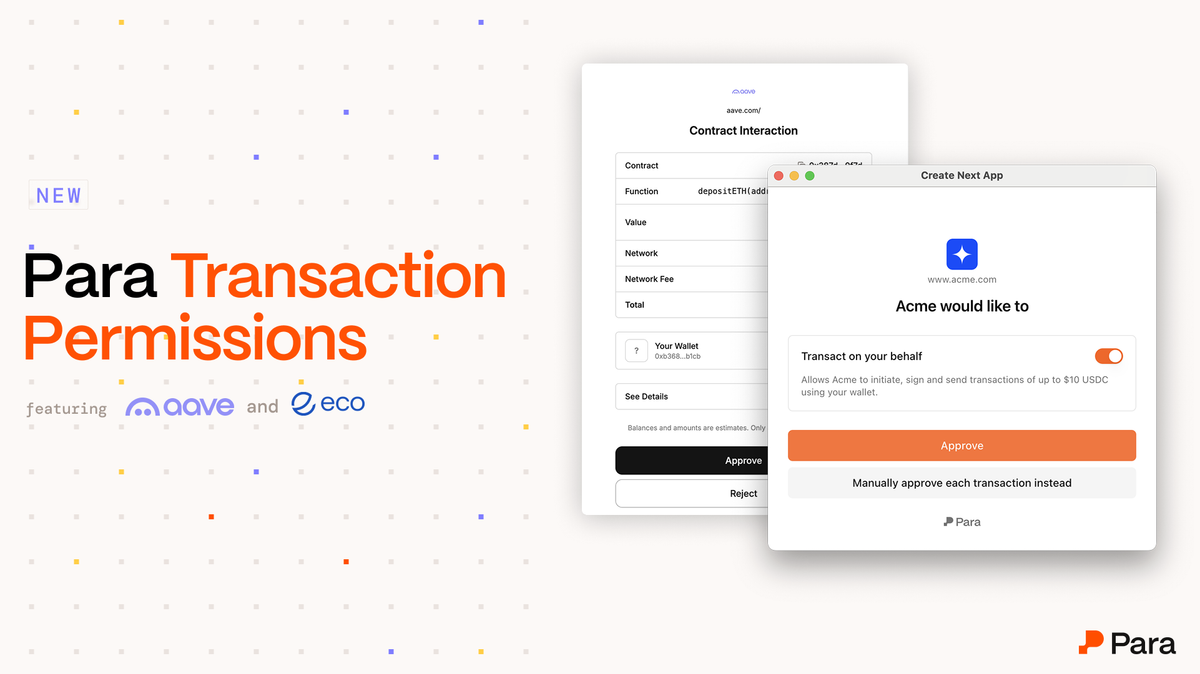
Today, we’re excited to announce the launch of Para Transaction Permissions. Para Permissions bridge this gap by enabling granular wallet access to applications via programmable scopes and conditions, in partnership with Aave and Eco.
Crypto is growing up. However, the transaction rails often still feel like the wild west.
That’s because transactions are rudimentary and functionally primitive –irreversible, immutable, and all-or-nothing. In many cases, that can be a good thing; it allows intermediary-free transactions, a powerful primitive missing from the current financial system.
However, bridging this with the UX consumers and institutions expect is anything but seamless. Take a simple action, depositing funds into an application, as an example:
A user hits “Deposit,” and suddenly they’re juggling a wallet prompt, a token approval, a bridge, a gas decision, and a final transaction that looks nothing like what the app promised.
This may work for crypto-natives. But for consumers and fintechs, that’s a lot of prompts, a lot of confusion, and a lot of room for mistakes. The other side of this coin isn’t much better: granting an application unilateral access to a wallet is a security disaster waiting to happen.
Today, we’re excited to announce the launch of Para Transaction Permissions. Para Permissions bridge this gap by enabling granular wallet access to applications via programmable scopes and conditions, in partnership with Aave and Eco.
Introducing Para Transaction Permissions.
Transaction Permissions are OAuth Scopes, Upgraded for Crypto
Crypto’s biggest asset and liability has simultaneously been it’s all-or-nothing nature. You either have a private key or you don’t. Para’s Distributed MPC model was engineered from day 1 to provide the programmability and expressiveness needed for transactions to be the primitive of money.
Think of Para Permissions like improved OAuth scopes, but for crypto transactions. Instead of popups on every action or granting broad, hard-to-reason-about approvals, users grant specific, auditable permissions to applications, tied to the exact contextual actions they’re trying to take.
OAuth got the internet unstuck. It gave apps a standard way to ask for access like:
- “Read your profile”
- “Send email on your behalf”
- “Access calendars, but only events”
The key idea was scope. Users shouldn’t have to hand over their whole account to do one useful thing. Onchain, “approvals” often behave like the worst version of OAuth:
- Unclear scope
- Overly broad access
- Difficult to audit
- Easy to forget
- Risky by default
Transaction Permissions flip the model. Apps ask for exactly the authority they need, for exactly the scope the user expects, for exactly the time window that makes sense.
What “Transaction Permissions” Actually Mean
At a high level, transaction permissions are a way to pre-authorize a specific action so the app can complete it reliably.
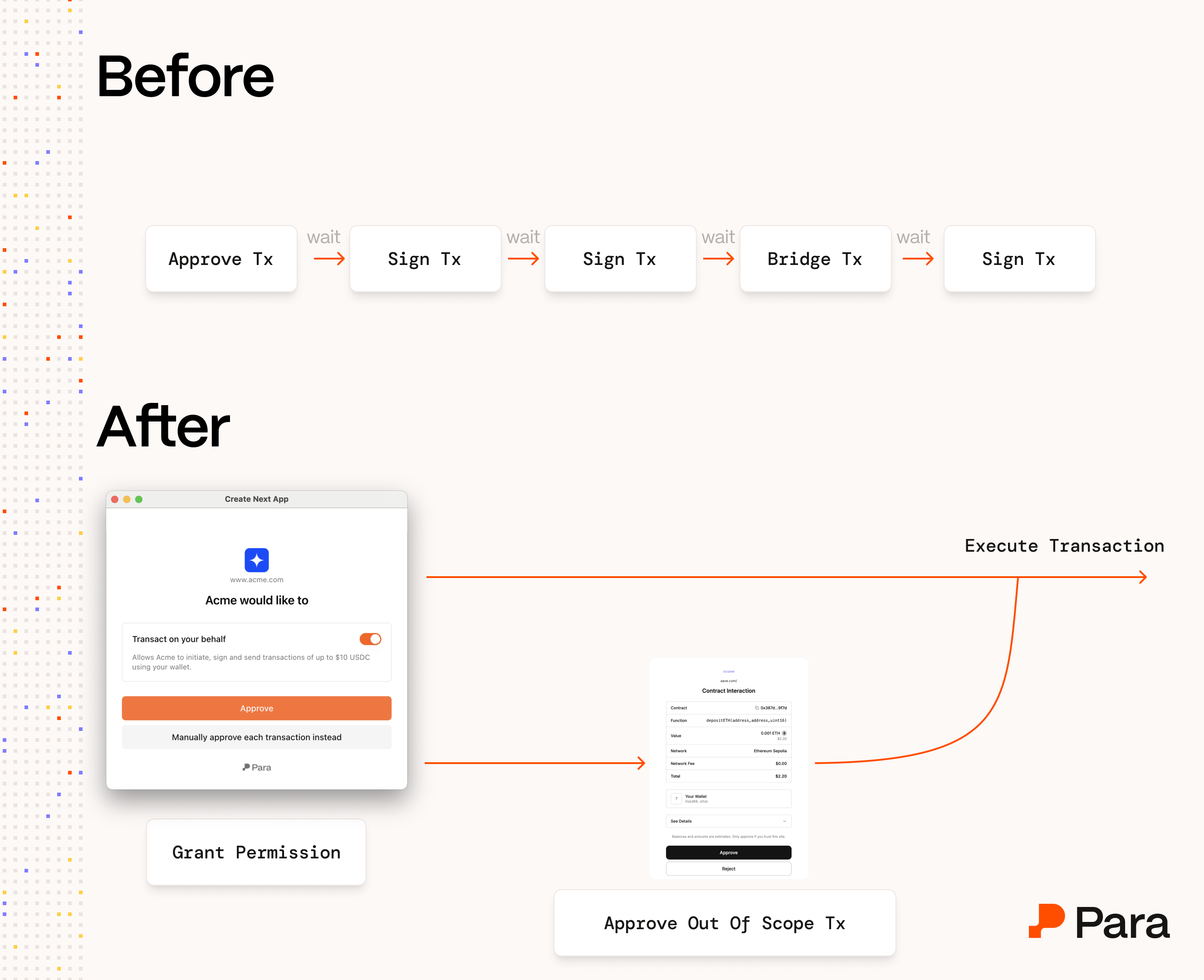
Instead of: Approve Token → "Sign Tx" → "Wait" → "Sign Another Tx" → "Bridge" → "Sign Again"
You Get:
→ User grants a scoped permission (like an OAuth scope) upon login
→ User signs the intended action
→ Application executes within the agreed boundaries
A strong permissions model should be:
- Scoped: limited to specific contracts, assets, methods, chains, and caps
- Understandable: the user recognizes what they’re allowing
- Revocable + expiring: permissions end when they should end
- Auditable: apps can prove what was requested vs what was executed
For fintechs, that translates to fewer edge cases, fewer support tickets, and a path to introduce yield or onchain settlement without asking users to become crypto-native overnight.
Example 1: Aave Powers Compliant Stablecoin Yield for Fintechs
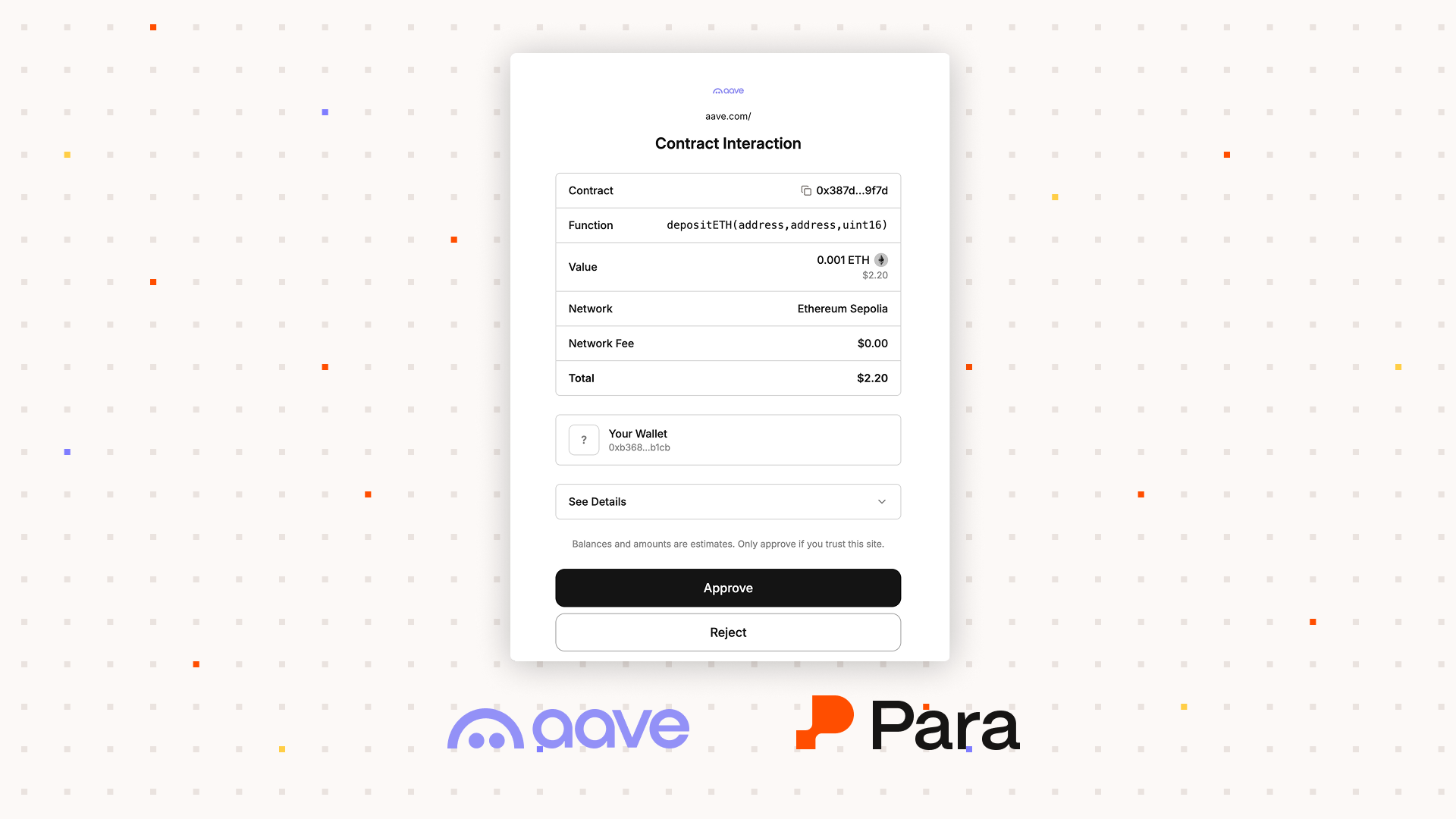
Aave is one of the most established DeFi lending protocols, but to “integrate Aave” means something very different for a fintech than it does for a crypto power user.
The Para Aave sandbox enables a simpler flow: A 1-click deposit into a basket of compliant stablecoins (PYUSD, RLUSD, USDC), in one go:
Instead of a user granting a broad approval that could be reused in surprising ways, the user grants a deposit scope that’s constrained by design:
- Restricted to specific stablecoins
- Restricted to Aave
- Restricted to a deposit policy
Depositing is still depositing. The difference is the trust envelope. Fewer prompts means fewer drop-offs. Clearer scope means fewer “what did I just approve?” moments.
Example 2: Eco Powers Cross-Chain Stablecoin Orchestration with Just One Transaction
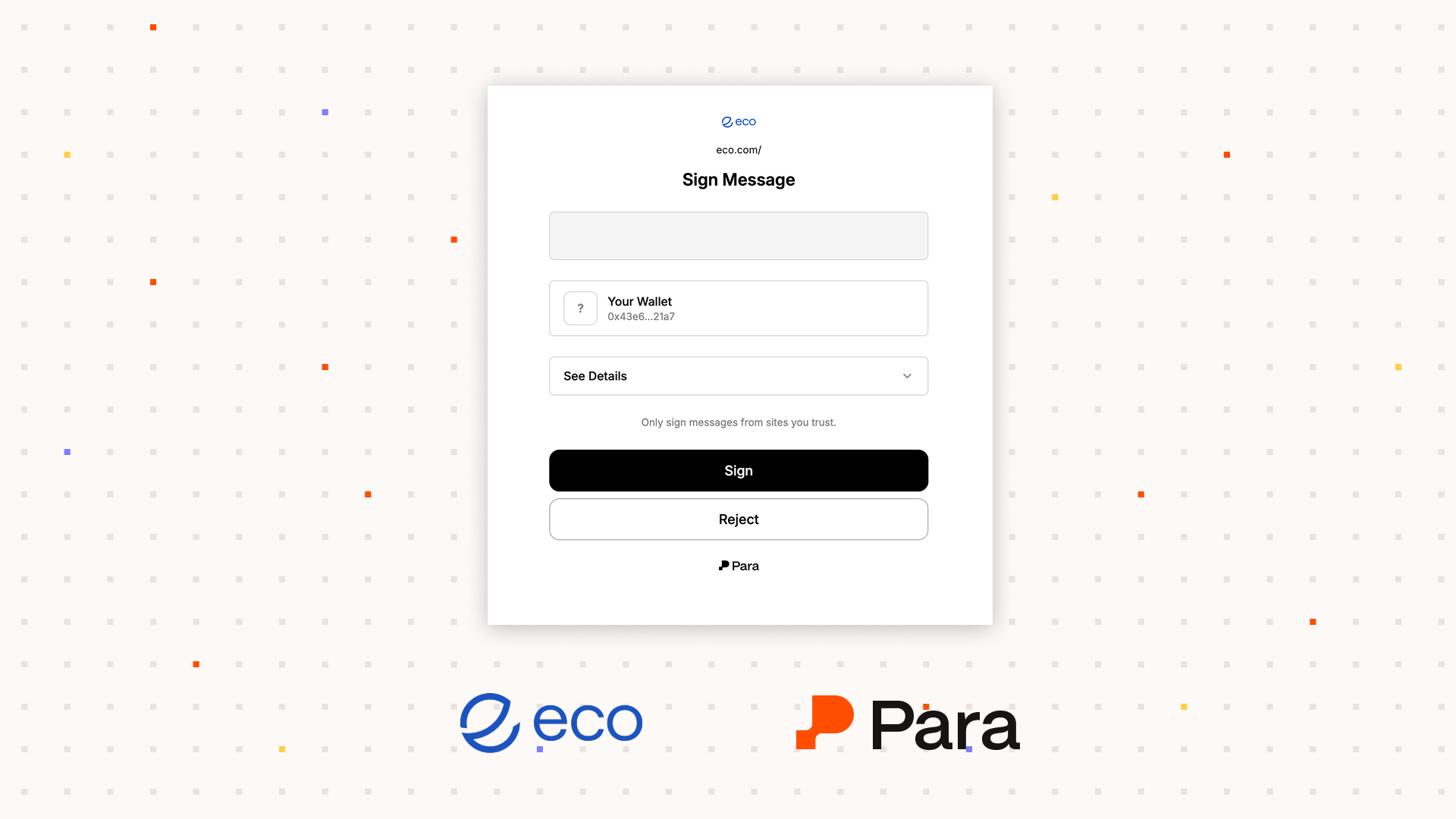
Cross-chain UX fails for a different reason. The user knows what they want to do, but their funds are on the wrong chain. Most apps solve that by sending users through a bridge flow. That usually means:
- Switching chains
- Approving tokens on a chain the user didn’t plan to use
- Signing multiple transactions
- Waiting and hoping nothing goes wrong
Eco’s user flow shows why Transaction Permissions matter beyond approvals.
The Para Eco Sandbox flow replaces a long chain of transaction and approval popups with: Permit 3 → sign transaction → approve
This allows balances from other chains to be moved seamlessly into the chain the user is currently trying to transact on, all in one transaction.
Permissions make that intent enforceable:
- The user grants a scoped permission that covers the specific movement required
- User signs the final action they care about
- The system pulls in the needed balances across chains as part of the same execution path
In OAuth terms, that’s the difference between:
- “Give this app access to everything forever”and
- “Let this app do this one action, right now, within tight limits”
What Makes an “OAuth-Grade” Permission System for Fintechs and Crypto
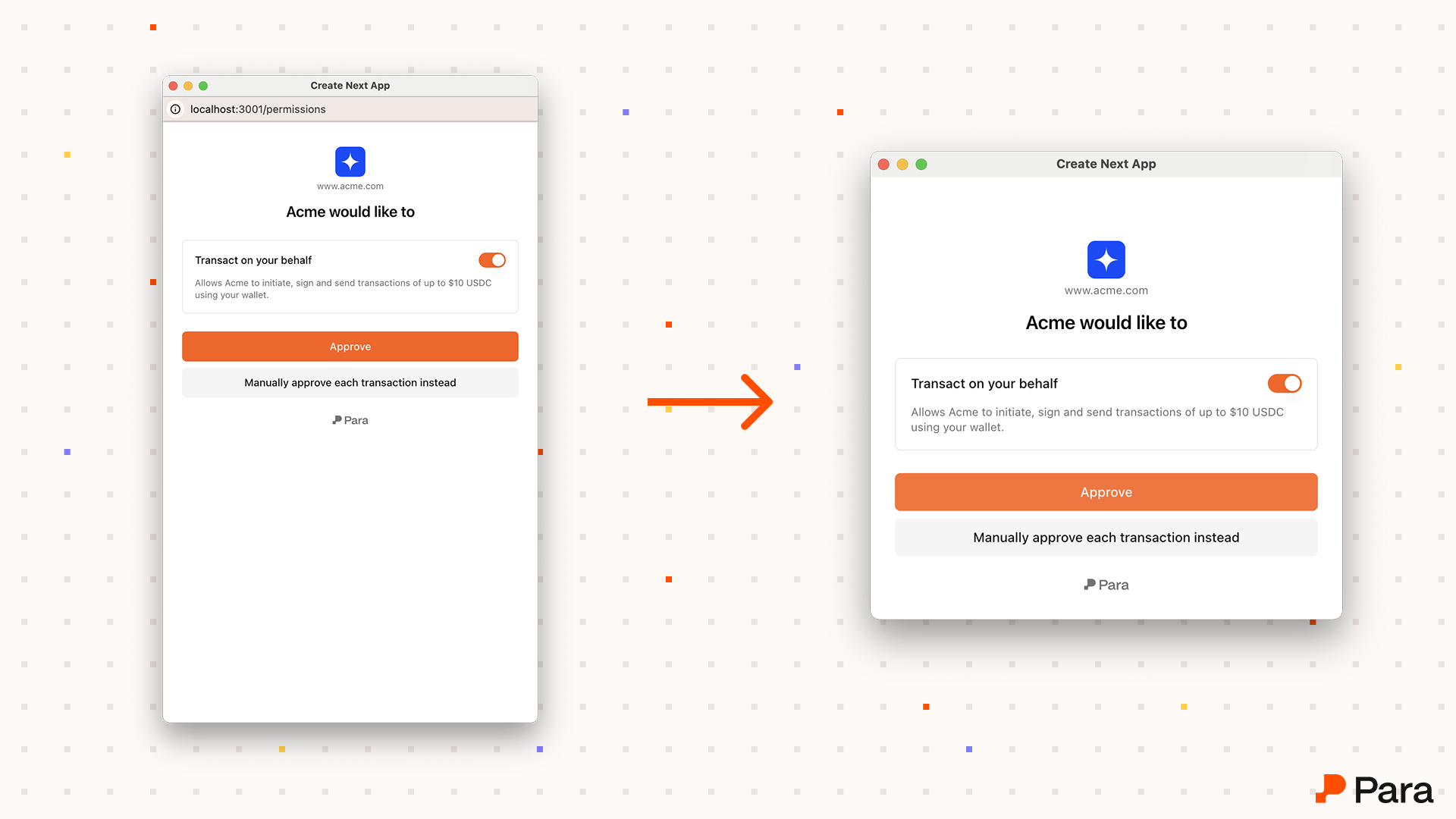
Transaction Permissions only work if the constraints are real and enforced:
- Fine-grained scopes: asset, contract, function, chain, amount, time
- Policy controls: allowlists, deny lists, runtime checks
- User clarity: explicit and auditable, but human-readable permissions
- Revocation and expiry: no zombie approvals
- Auditability: easy to inspect, prove, and reason about
Where Transaction Permissions Are Going
The obvious win is fewer prompts. The bigger win is letting teams ship onchain actions that feel like modern fintech.
Permissions unlock product surfaces that used to be too brittle, like earning yield without opaque approvals, payment on any chain without forcing chain switch popups, and automations.
Para already powers 100M+ transactions for 10M+ users via enterprise-grade wallet infrastructure. Transaction Permissions build on that foundation by turning authorization into a product primitive teams can trust and users can understand.
If you’re building a fintech flow that touches yield, payments, or cross-chain execution, Para Transaction Permissions can help you ship onchain programs that don’t sacrifice clear scopes and real-world controls.
→ Talk to us
→ Para Aave Permissions Sandbox
→ Para Eco Permissions Sandbox
→ Learn more about Permissions